Twenty years ago, applying for a business loan meant a stack of photocopies, a suit, and a meeting with a loan officer who might take a month to call back. Today, a business owner can upload bank statements from a phone during a lunch break and receive a decision before dinner.
That shift did not happen by accident. A wave of technology, from cloud accounting to machine learning, has rebuilt nearly every stage of the lending process. Understanding these changes helps owners take advantage of the speed and convenience while avoiding the new kinds of risk that come with them.
I. The Old Model and Its Limits
Traditional lending depended on a narrow set of information: tax returns, credit scores, collateral, and the lender’s personal judgment. The process was slow because every document had to be gathered, reviewed, and verified by hand.
It was also exclusionary. Young businesses, owners with thin credit files, and companies in industries banks considered risky often never made it past the first conversation. Small loan amounts were particularly hard to obtain, because the cost of manually underwriting a $25,000 loan was nearly the same as underwriting a $500,000 one.
Timing was another weakness. A business that needed money to seize a bulk inventory discount or repair a critical machine often could not wait weeks for an answer. Many owners turned to personal credit cards or loans from family simply because the formal system moved too slowly to meet urgent needs.
II. What Changed
Several technologies converged to transform the field.
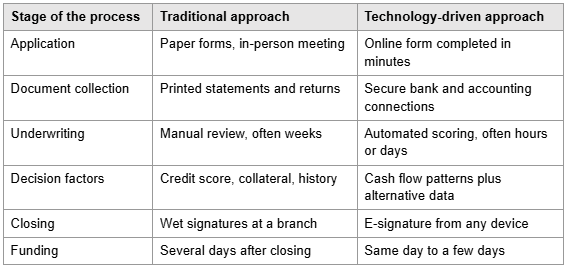
Cloud accounting. Platforms that store a company’s books online made real-time financial data available to lenders with the owner’s permission. Instead of relying on last year’s tax return, lenders could see this month’s revenue.
Open banking and data connections. Secure connections allow applicants to share bank transaction history directly, eliminating the need to download, print, and scan statements. Lenders can analyze deposits, balances, and spending patterns in minutes.
Alternative data. Some lenders now consider information beyond credit scores, such as payment processor volume, online reviews, shipping data, and accounting trends, to form a fuller picture of a business’s health.
Automated underwriting. Software can apply credit rules consistently and instantly, flagging only unusual files for human review. This dramatically reduced the cost of evaluating small loans.
Machine learning models. More advanced systems look for patterns in thousands of past loans to predict repayment, sometimes identifying creditworthy businesses that traditional criteria would have missed.
E-signatures and instant funding. Digital closings and faster payment rails mean funds can arrive in days, or in some cases the same day an application is approved.
Speed is now a feature of the product, not a favor from the lender.
III. Then and Now
IV. The Benefits for Business Owners
The advantages are real and significant.
Access has widened. Businesses that once had no realistic path to credit, including newer companies and owners rebuilding their credit, now have options. Small loan amounts have become practical to offer.
Speed has improved. When a piece of equipment breaks or a time-sensitive opportunity arises, fast funding can make the difference. Educational resources like Same Day Business Loans Online explain how expedited funding works and when it makes sense.
Convenience has increased. Owners no longer need to take a day away from the business to visit a branch. Applications can be completed after hours, from anywhere.
Transparency, in some corners of the market, has grown. Many platforms now present costs and terms more clearly, and comparison tools make it easier to understand how different offers stack up. Sites like Compare Business Loans Online help owners examine products side by side.
V. The New Risks
Technology solves old problems but introduces new ones.
Speed can encourage haste. When approval takes minutes, it is tempting to accept an offer without reading carefully. Fast products, such as merchant cash advances and short-term loans, often carry higher costs. Resources dedicated to these products, such as Best MCA Loans, can help owners understand factor rates and holdback percentages before signing.
Easy applications encourage over-applying. Because an online form takes only a few minutes, some owners submit them to many lenders at once. This is one of the most damaging habits in modern borrowing. Each application can trigger a credit inquiry, and several inquiries in quick succession can lower a credit score and raise red flags with underwriters. Lenders’ systems detect this pattern instantly. Some automatically decline files showing heavy recent shopping activity, while others reduce offer amounts. Owners also become targets for aggressive follow-up calls and emails from parties they never contacted.
The better approach is old-fashioned discipline applied to a modern process: research thoroughly, identify the single lender or platform that best fits your needs, and submit one complete application. If that does not work, move to the next option deliberately.
Data privacy matters. Connecting bank and accounting accounts gives lenders deep visibility into your business. Before granting access, understand what data is collected, how it is used, and whether it is shared with third parties.
Algorithms are not infallible. Automated systems can misread unusual but healthy businesses, such as companies with lumpy, project-based revenue. If you believe a decision is wrong, ask whether a human review is available.
Scams have gone digital, too. The same tools that make legitimate lending efficient also make fraud easier to disguise. Polished websites, cloned company names, and unsolicited text messages promising guaranteed approval are common warning signs. Legitimate lenders do not require upfront fees before funding, and they do not pressure you to decide within minutes. Verify a company’s physical address, licensing where applicable, and reviews from independent sources before sharing any financial information. If an offer arrives from a company you never contacted, treat it with extra caution, and never send login credentials for your bank account through email or text.
VI. How to Use Technology to Your Advantage
A few practices help owners benefit from modern lending without falling into its traps.
• Keep your books in the cloud and up to date. Clean, current financials make every application faster and stronger.
• Research before you connect anything. Learn which lenders and platforms serve businesses of your size, industry, and credit profile. Directories and guides like Business Loans Engine can help narrow the field before you share any data.
• Choose one provider and apply once. Let the speed of technology work for you by applying where you are most likely to fit.
• Read every term, even on a phone screen. Download the agreement if necessary and review it on a larger display.
• Monitor your credit. Many free tools now alert you to new inquiries and account changes.
VII. What Comes Next
The trend toward faster, more data-driven lending will almost certainly continue. Embedded financing, where loans are offered directly inside accounting software, payment platforms, and e-commerce marketplaces, is becoming more common. Real-time underwriting that adjusts credit limits as a business grows may become standard. Artificial intelligence will likely play a larger role in both evaluating applications and helping owners compare options.
For business owners, this means financing offers may increasingly appear inside the software they already use every day. A bookkeeping app might suggest a line of credit after noticing a seasonal dip. A payment processor might offer an advance based on recent sales. These offers can be convenient, but convenience is not the same as suitability. The same questions apply regardless of where an offer appears: what does it cost in total, how is it repaid, and does it fit the actual need?
Regulation is also evolving, with growing attention to disclosure standards for commercial financing in several states. Owners can expect clearer cost information over time, though the responsibility to read and understand terms will remain with the borrower.
Why Careful Borrowing Still Matters
Technology has made business lending faster, broader, and more convenient than at any time in history. But the fundamentals of smart borrowing have not changed. Know what you need and why. Research the market carefully. Choose the lender that best matches your situation and apply there first. Read everything before you sign.
The tools are new. The discipline that makes them work is timeless, and the owners who pair modern convenience with careful judgment will continue to secure the best outcomes.
Disclaimer: This article is for informational purposes only and does not constitute financial, lending, legal, or professional advice. Business financing products, eligibility requirements, costs, terms, credit practices, and approval criteria vary by lender and individual circumstances and may change over time. Readers should carefully review all financing terms and consult a qualified financial professional or lender before making borrowing or other financial decisions.