A bridge loan is worth it when the value it protects or captures exceeds everything it costs, including the costs that show up only if your exit runs late. That’s a formula you can actually fill in:
Most owners only estimate the first two terms. The rest of this article does the whole calculation, using one fictional company under four outcomes. The numbers are illustrative, and bridge pricing in the real market varies widely by collateral, risk, and lender.

The Deal on the Table
Ashgrove Cold Storage has signed a contract with a regional grocer. Serving it requires $150,000 of refrigeration upgrades in the next few weeks. Ashgrove’s bank has indicated it will likely provide longer-term financing, but closing is expected to take around four months. Without the upgrades, the contract goes away.
The owner estimates that the contract’s first-year gross profit is $62,000. A bridge offer would cover the gap:
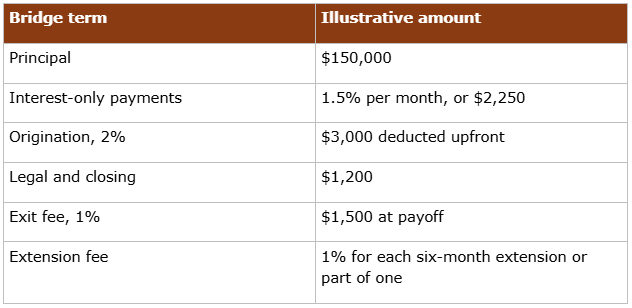
Pages such as Fundivi bridge capital details show how a provider may frame this type of short-term funding. Compare whatever a provider describes against the actual fee schedule in your own offer, line by line.
Scenario 1: The Exit Happens on Time
The bank closes in four months and pays off the bridge.
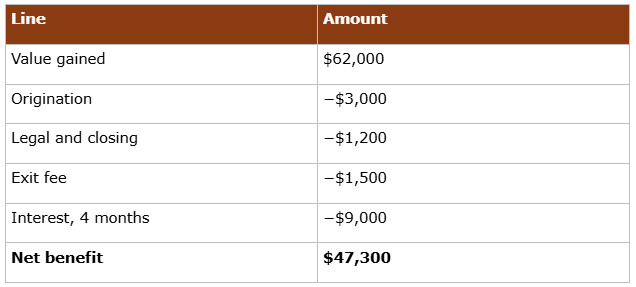
Total cost is $14,700. Because of the fees, the annualized cost comes to about 30% on the $145,800 Ashgrove really receives, even though the stated monthly rate looks modest. That’s expensive money, and in this case it’s still clearly worth paying.
This is the case for bridge loans. Speed captures value that slower money would have lost.
Scenario 2: The Exit Runs Five Months Late
Bank files stall, an appraisal has to be redone, and payoff takes nine months. Each month of delay adds $2,250, and one extension fee applies.
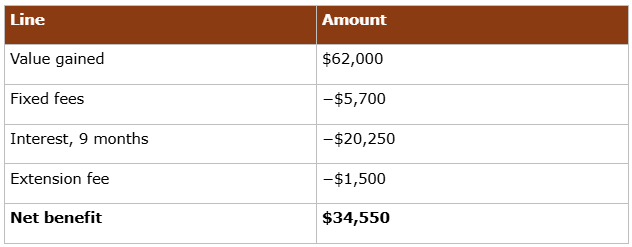
The delay wipes out $12,750 of benefit. The loan was still worth taking, yet this result should change how you read a quote. Interest isn’t the only term that matters. The real question is how much each month past your target date costs.
Bank timing deserves the most skepticism in this entire calculation. Look at how term lending is moving before assuming your takeout will close quickly. This AP release on term loan lending figures is one recent item on the subject, though your own lender’s written timeline matters far more than any market headline.
Scenario 3: The Exit Fails
The bank declines. Ashgrove carries the bridge for 12 months, pays for two extensions, and must then sell equipment at a discount to clear the balance. The contract yields less than expected because of the disruption.
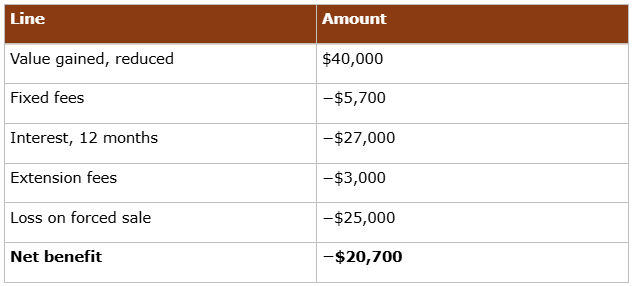
Now the loan has destroyed value. If the bridge had been secured by real estate or by a personal warranty, the owner’s exposure could extend well beyond the $20,700.
Scenario 4: The Value Was Thin All Along
Run Scenario 1 again, but assume the benefit was only $12,000. Perhaps the owner wanted the upgrades sooner for convenience, and the contract wasn’t actually at risk.
Costs remain $14,700, so the net benefit is −$2,700, even with a perfect exit. The on-time cost of $14,700 is your break-even hurdle. If you can’t credibly name a benefit larger than that figure, stop here.
All Four Outcomes, Side by Side
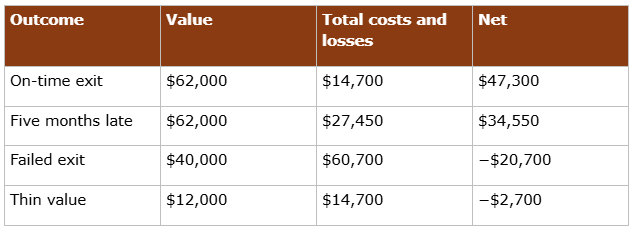
Before signing, assign rough probabilities to these outcomes using your best judgment, and don’t let the on-time row be your only row. Ask the question this way: could the business survive the failed-exit row? If it couldn’t, the expected value doesn’t really matter.
Think about smaller alternatives as well. A retail or online seller needing to bridge a stock purchase might find that a look at working capital loans for ecommerce sellers reveals simpler products for a short inventory gap, with no takeout required.
Where the Value Number Comes From
The first term in the formula is the one most easily inflated, so be strict about it. Count only the gain that depends on having the money now. Ashgrove’s $62,000 qualifies because the contract would vanish without the upgrades. Profit that the company could still earn by waiting four months doesn’t qualify, and neither does the general comfort of having funds on hand.
Use gross profit after the extra labor, power, and supplies the new work requires, not the revenue. If the benefit extends beyond the first year, count those later years conservatively, and only if the customer has actually committed to them. A verbal assurance from a buyer is a reason to hope, and not a figure for the spreadsheet.
The Pros, Stated Plainly
- Speed where it has a price. Bridges can secure deals that slower financing would lose.
- Interest-only payments. Cash flow is often lighter during the gap than under an amortizing loan.
- Collateral focus. Some lenders put more weight on the asset and exit than on recent earnings.
- Defined purpose. The debt has a planned ending, unlike open-ended revolving credit.
The Cons, Stated Just as Plainly
- High total cost. Rates and stacked fees make this costly compared with long-term financing.
- Balloon risk. The whole principal typically comes due at the end.
- Exit dependence. Your repayment often relies on a third party that you don’t control.
- Serious security. Liens and warranties are common, so a failed exit can reach important assets.
- Extension charges. Delays usually become more expensive right when you have the least leverage.
- Refinancing pressure. A lender that knows your balloon is coming may have little reason to offer you generous takeout terms.
Stress Tests to Run Before You Sign
- Add three to six months to your exit date and recompute the net benefit.
- Cut your value estimate by a third.
- Get the exit in writing, such as a commitment letter or signed purchase contract, and read its conditions.
- Ask whether interest is charged on the full amount or only on money drawn.
- Ask whether a minimum interest period applies if you pay off early.
- Identify the second exit, the plan you’d use if the first one fails.
- Confirm who can declare a default, and whether a missed appraisal or a late document counts as one.
- Ask for a full payoff statement example, so that you can see every charge that would apply on the last day.
If you’re using comparison resources, the CompareBusinessLoansOnline.com bridge lender research page is one place to learn about the options that exist. Treat anything you read as a prompt for questions, then get real terms from a lender.
Frequently Asked Questions
How long do business bridge loans usually last?
Often from a few months to about a year or two, depending on the lender and collateral.
Is a bridge loan the same as a hard money loan?
They overlap. Hard money describes a lender that focuses on collateral, and many such lenders offer bridge loans, but not every bridge loan is hard money.
Can a bridge loan be repaid early?
Often, but check for a prepayment fee or a minimum interest requirement, which may reduce any savings.
Do I need collateral?
Commonly, yes. Some short-term products are marketed as unsecured, but they may still require a warranty or general lien.
What counts as a credible exit?
A committed loan, a signed sale, or contracted receivables are stronger than a hope that refinancing will be available.
Should I count tax effects in net benefit?
A precise analysis should. Interest may be deductible, so ask your tax professional how it affects your numbers.
What if my bridge lender and takeout lender conflict?
Your long-term lender may require first position on the collateral. Confirm that the bridge can be paid off and its lien released at closing.
Disclaimer: This content is for general informational purposes only and should not be considered as financial advice. The content is not intended to be a substitute for professional financial advice, investment advice, or any other type of advice. You should seek the advice of a qualified financial advisor or other professional before making any financial decisions.