

By: Leah Prescott
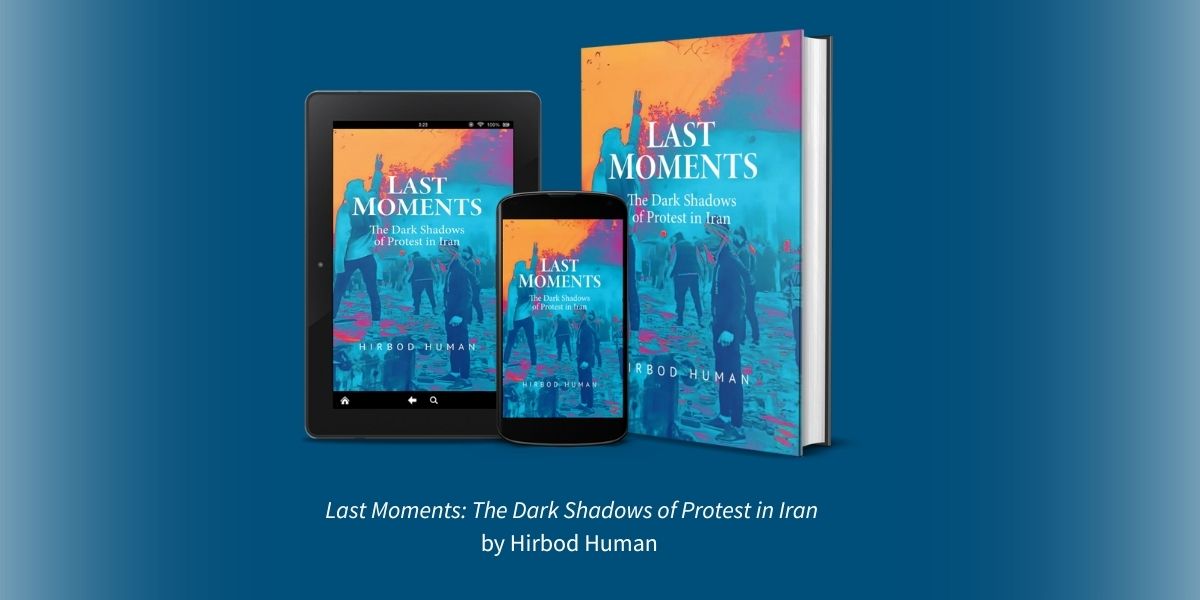
When Hirbod Human talks about Last Moments: The Dark Shadows of Protest in Iran, he doesn’t frame it as a book meant to persuade. He describes it as more like a witness. The goal, he says, is not to guide readers toward a tidy conclusion, but to place them inside a moment where everything shifts. A door opens. A voice rises. A body is stopped, searched, or carried away. From that second on, life no longer looks the same.
Listening Before Writing
Hirbod’s journey to this book didn’t begin at a desk. It began in years of listening. Through radio programs, audio work, and online human rights education, he moved between people who had survived the system and people who had once worked inside it.
He spoke with victims and families, but also with interrogators, guards, and officials. What interested him was not only the pain repression leaves behind, but the thinking that allows it to exist. He wanted to understand how a structure turns into a machine that produces both fear and obedience.
The Moment That Changed the Direction
The death of Mahsa Amini and the Women, Life, Freedom uprising became a turning point. As images and slogans traveled around the world, Hirbod felt a growing gap between what people outside Iran saw and what life in Iran actually felt like.
He saw headlines and hashtags. But he also knew the quieter reality that lives in the body and the home. He chose short stories because they could do something a long argument could not. A short story can enter a single room, show what happens there, and leave the reader alone with it.
When Ordinary Life Becomes Risk
For Hirbod, there is no clean line between daily life and politics in Iran. Joy itself can become a risk. Singing, touching, laughing, and even standing in the wrong place can turn into a problem.
That pressure is always present, like an invisible checkpoint people carry in their own minds. His stories reflect that. A drive in a car. A visit to a hospital. A moment at an airport. These scenes are not meant to feel dramatic at first. They are meant to feel familiar. The weight arrives suddenly, often without warning.
Writing Without Exposing Lives
Many of the moments in Last Moments come from real conversations built on trust. That meant storytelling came with responsibility. Hirbod changed details, merged experiences, and shifted settings to make sure no life could be traced back to the page.
For him, the challenge was not about making scenes more powerful. It was about making them safer. A story could not become a trail that led back to someone who had already risked so much by speaking.
The Scene That Nearly Broke Him
One of the hardest stories for Hirbod takes place in a hospital. It centers on a nurse and a young protester whose injuries cannot be hidden or softened.
This was where he felt something break inside him. The reality of bodies harmed in ways meant not only to wound but to erase stayed with him long after the page was finished. He didn’t try to smooth that pain out of the writing. He stayed with it, even when it meant working through tears.
A Book That Asks for Presence, Not Agreement
Hirbod doesn’t ask readers to applaud or align with a position. He asks them to stand inside for a moment.
He believes that once someone feels that closeness, abstract phrases like human rights begin to change shape. They stop being ideas and start becoming faces, families, and bodies that can be hurt or protected.
Beyond Flags and Arguments
He is critical of how countries and conflicts are often turned into symbols in larger global debates. In those conversations, he feels Iranian lives can become secondary, reduced to talking points instead of lived realities.
Diplomacy becomes a way to delay responsibility. Democracy becomes a word used for branding instead of a daily practice. His book draws attention back to the human cost beneath those big frames.
What Comes Next
Hirbod doesn’t separate those who suffer from those who carry out harm as neatly as many people might expect. He talks about indoctrination, fear, poverty, and humiliation as forces that shape both sides of the system. This isn’t an excuse, he says. It’s a way of showing how damage can pass from one person to the next.
Looking ahead, he doesn’t want to turn pain into a personal style. He writes about suffering only when not writing would feel like another form of erasure. His next project moves into a quieter space, following an immigrant who believes he has succeeded, only to discover, through a single encounter, how much work remains within himself.
The Question That Ties It All Together
The thread running through Hirbod Human’s work isn’t politics. It’s a question.
What does it take to remain human?
In Last Moments, that question lives in small, sharp scenes where pretending becomes impossible. These are not stories about chasing heroism. They are records of thresholds, the seconds when continuing as before is no longer an option.
For Hirbod, that is where truth begins to speak. Not loudly, but in a way that is very hard to forget.
Discover Last Moments: The Dark Shadows of Protest in Iran. Order your copy now on Amazon or Barnes & Noble.
Disclaimer: This article reflects the personal insights of Hirbod Human, author of Last Moments: The Dark Shadows of Protest in Iran. It aims to inform, not promote a political agenda. The book is mentioned for informational purposes and is available for purchase through platforms like Amazon and Barnes & Noble. The content addresses sensitive topics with respect, ensuring anonymity for those involved. It does not seek to sensationalize or exploit the issues discussed.