Most great American cities trace their origins to soldiers, speculators, or railroad barons, almost always men. Miami is the exception. The city on Biscayne Bay owes its existence to Julia Tuttle, a widowed businesswoman from Ohio who saw a city in a near-empty stretch of subtropical wilderness and willed it into being. Known ever since as the “Mother of Miami,” Tuttle holds a distinction no other woman in the country shares: she is the only woman credited with founding a major American city.
A Vision in the Wilderness
Julia DeForest Tuttle was born in Cleveland in 1849. After her husband died in 1886, she made a decision that would have struck her contemporaries as eccentric. In 1891 she moved south to the mouth of the Miami River, purchasing 640 acres on its north bank, land that today encompasses much of downtown Miami. When she arrived, she was one of only a handful of people living at the river’s mouth. There was no city, no rail line, and little reason for anyone to expect one.
But Tuttle saw what others did not. She believed the warm, frost-free climate and deep-water bay could support a thriving metropolis, declaring her intention to make it the greatest city in the southland. The obstacle was access. Without a railroad connecting the isolated outpost to the rest of the country, her vision would remain a wilderness fantasy.
The Campaign to Bring the Railroad
Tuttle understood that transportation was everything, and she launched a relentless campaign to court the two railroad magnates extending lines through Florida. She first approached Henry Plant, whose railroad terminated in Tampa, and was rebuffed. According to one account passed down by local historians, Plant dismissed her flatly, telling her he had no intention of running his railroad across miles of trackless wasteland to satisfy her ambitions.
She then turned to Henry Flagler, the Standard Oil partner and fellow Clevelander who was building the Florida East Coast Railway down the Atlantic side of the state. Tuttle wrote to him repeatedly, even traveled to meet him in person, and offered to give up half of her land if he would extend his tracks to Biscayne Bay. For a long time, Flagler declined.
The Freeze That Changed Everything
What Tuttle’s persistence could not accomplish, nature did. The Great Freeze of 1894 and 1895 devastated central and northern Florida, wiping out the citrus groves and the fortunes built on them. The disaster proved Tuttle’s central argument: that the land around the Miami River, untouched by the frost, offered something the rest of the state could not.
As the enduring legend has it, Tuttle drove the point home by sending Flagler fresh orange blossoms, proof that the freeze had spared the far south. Whether the blossoms alone changed his mind or simply confirmed what the freeze had already demonstrated, Flagler agreed. In exchange for land from Tuttle and from the neighboring Brickell family, he extended his railroad and promised to build a grand hotel to draw tourists.
A City Is Born
The first train rolled into the settlement in April 1896, and the transformation was immediate. Within weeks, the new community had its first newspaper, the Miami Metropolis, and its first bank. On July 28, 1896, the City of Miami was formally incorporated, with a population of just over 500.
There is a striking irony in the moment of founding. Tuttle, the woman whose vision and persistence made the city possible, could not participate in its incorporation. Women did not yet have the right to vote, so the formal act of creating the city she had conjured was carried out by the men around her. Flagler built his Royal Palm Hotel, which opened in 1897 and quickly drew Gilded Age titans like the Rockefellers and Vanderbilts.
A Legacy Long Overlooked
Tuttle did not live to see her city flourish. Having taken on heavy debt to make the railroad deal work, she died in 1898 at age 49, and her children sold off much of her land to settle what she owed. For a time, her name faded from the story she had authored.
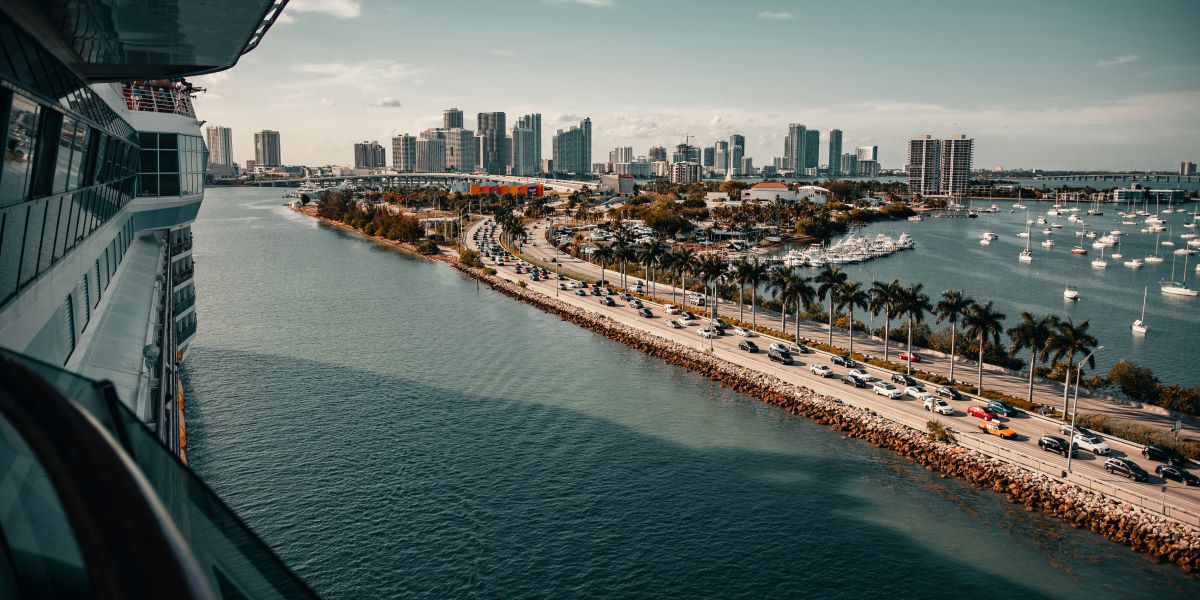
History has since restored her. Today more than 100,000 drivers cross the Julia Tuttle Causeway between Miami and Miami Beach each day, and a statue honors her at Bayfront Park. Historians have also begun to broaden the picture, increasingly recognizing Mary Brickell, Tuttle’s equal in business acumen, as another mother of Miami whose land and dealings were essential to the city’s birth.
That fuller telling does not diminish Tuttle’s distinction so much as deepen it. Miami was not founded by a general planting a flag or a company chartering a port. It was founded by a woman with a deed, a vision, and the persistence to talk one of the most powerful men in America into building a railroad to nowhere, until that nowhere became a city. In the long roster of American urban origins, that remains a singular achievement.