
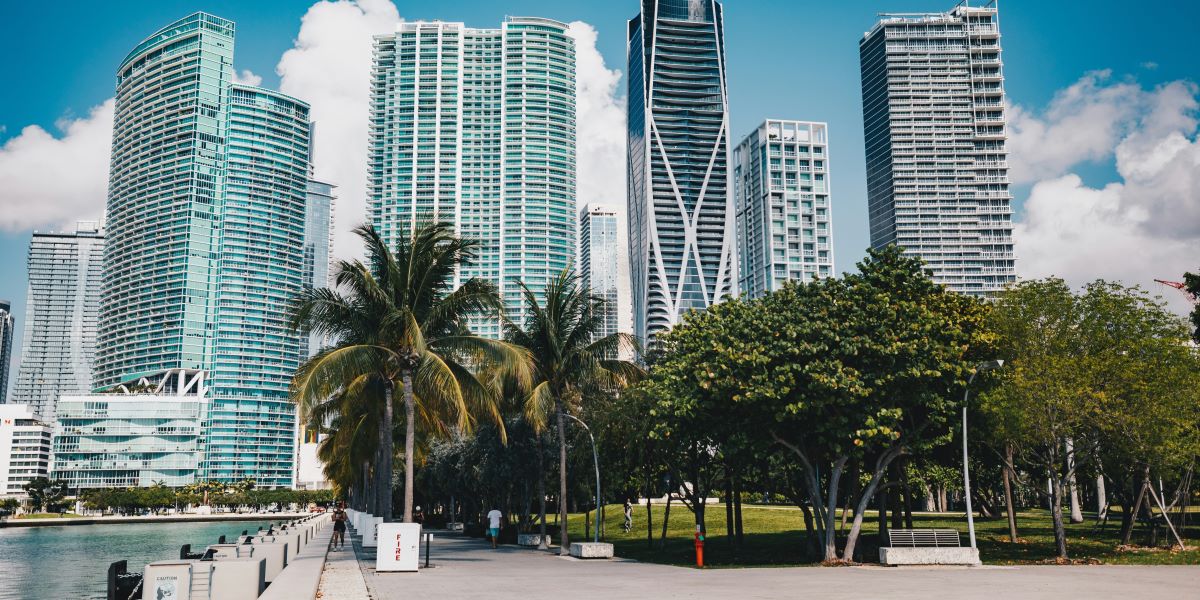
Miami’s startup ecosystem has reached an estimated $95 billion in total valuation, backed by $832 million in venture capital raised by Miami-area startups in the second quarter of 2026 alone, a pace that would exceed the $4.13 billion South Florida attracted in all of 2025. The milestone is anchored by two headline corporate relocations, Palantir Technologies moving its global headquarters from Denver to Aventura in February and cybersecurity firm Varonis relocating from New York City to Brickell, along with six active unicorns and a startup density that now ranks among the highest in the country. The data marks a shift from the narrative-driven “Miami moment” of 2021 to a tech economy that is now generating the capital deployment and headquarters decisions that define a durable hub.
Key Takeaways
- Miami’s startup ecosystem is valued at approximately $95 billion, ranking 22nd globally and climbing six positions year over year in the StartupBlink Global Startup Ecosystem Index 2026.
- Miami-area startups raised $832 million in Q2 2026, putting the region on pace to exceed the $4.13 billion South Florida raised in 2025; Q1 2026 added another $1.15 billion.
- Palantir Technologies moved its headquarters from Denver to 19505 Biscayne Boulevard in Aventura on February 17, 2026, becoming the largest publicly traded company headquartered in South Florida with a market cap above $300 billion.
- Varonis, a Nasdaq-listed data security firm, relocated from New York City to 801 Brickell Avenue in the same month, occupying the entire 11th floor for its executive and research teams.
- Six active unicorns are based in the Miami area, including Flow ($3 billion valuation), Kaseya ($2 billion), and MoonPay, spanning real estate, IT management, and fintech.
- Dominant sectors include fintech, proptech, medtech, Latin America-focused startups, and a growing artificial intelligence corridor.
The Palantir Move Changed the Conversation
On February 17, 2026, Palantir Technologies posted a single sentence on X: “We have moved our headquarters to Miami, Florida.” The announcement, made without advance notice to Colorado’s governor or Denver’s mayor, immediately altered the scale of Miami’s corporate recruitment narrative. Palantir’s SEC filings now list its principal executive office at 19505 Biscayne Boulevard, Suite 2350, in Aventura, an affluent suburb roughly 20 miles north of downtown Miami.
The relocation is significant for several reasons beyond symbolism. Palantir is valued at more than $300 billion, making it the largest publicly traded company headquartered in South Florida and surpassing NextEra Energy. The firm reported net income of $1.6 billion on $4.5 billion in revenue for 2025, with 2026 revenue projected near $7.2 billion. It employs approximately 4,429 people worldwide, with roughly 600 previously based at its Denver office. The company has not specified how many employees will relocate to Florida.
The move was orchestrated by CEO Alex Karp and co-founder Peter Thiel, both of whom have maintained residential presences in South Florida for years. Thiel has operated Founders Fund and Thiel Capital from Miami Beach since 2020. The headquarters officially registered at an Industrious co-working space in Aventura, though the company has been actively scouting permanent office space in Wynwood, Brickell, and Coral Gables.
Palantir’s arrival in Miami follows a pattern of founder-led relocations where executives’ personal preferences for Florida’s tax environment and lifestyle ultimately pull corporate infrastructure south. Citadel completed the same trajectory in 2022 and has since grown to 500 local employees, making Miami its third-largest office globally. The difference with Palantir is scale: a $300 billion enterprise AI and government-contracting company choosing Miami as its legal home sends a signal to the enterprise technology sector that the region can anchor firms operating at the highest levels of government and commercial complexity.
Varonis Brings Cybersecurity Weight to Brickell
Palantir was not the only Nasdaq-listed company to relocate to Miami in February. Varonis Systems, a publicly traded cybersecurity firm specializing in data security posture management and automated threat detection, moved its headquarters from New York City to the Brickell Financial District. The company now occupies the entire 11th floor at 801 Brickell Avenue, housing its executive leadership and security research staff.
Varonis’ relocation carries its own significance for the Miami ecosystem. Cybersecurity is foundational infrastructure for the digital economy, and the presence of a Nasdaq-listed leader in the space strengthens what local economic development organizations have described as a “cyber-corridor” forming between Brickell and Coral Gables. The move also demonstrates that Miami can compete with New York City for the headquarters of established, publicly traded technology companies, not only for startups seeking lower costs and warmer weather.
The Funding Pipeline Is Accelerating
The ecosystem’s valuation is not static. Venture capital inflows have accelerated year over year, building a funding trajectory that increasingly resembles a sustained growth curve rather than a post-pandemic spike. South Florida startups raised $4.13 billion in 2025, up sharply from $2.7 billion in 2024, according to the eMerge Americas Insights Report. In Q1 2026, Pitchbook data showed South Florida startups pulling in $1.15 billion, led by medtech deals. The $832 million raised in Q2 keeps the region on pace to exceed the prior year’s total.
The funding is distributed across sectors that reflect Miami’s geographic and cultural position. Fintech remains the flagship vertical, supported by both consumer and business-focused financial products. Proptech is rising alongside the region’s real estate market, with startups applying AI and data analytics to property management, development, and transactions. Medtech has emerged as a growth category, driven in part by the concentration of healthcare systems and research institutions in the metro area. Latin America-focused startups continue to leverage Miami’s position as the commercial bridge between U.S. and LatAm markets.
The AI sector is generating some of the most visible new investment. In June 2026, technology investor Bob Zangrillo revived plans for a $3 billion, 7.8-million-square-foot mixed-use development in Little Haiti, now pitched as an AI campus designed to attract tenants in artificial intelligence, asset management, and venture capital. The project includes more than 2,600 residential units, a hotel, retail space, and an office complex targeting the AI vertical specifically.
Six Unicorns and What They Represent
Miami’s six active unicorns span a range of sectors that mirror the ecosystem’s diversity. Flow, the real estate company backed by Andreessen Horowitz and valued at $3 billion, represents the proptech vertical. Kaseya, an IT management software provider valued at $2 billion, anchors the enterprise technology category. MoonPay, a fintech company that simplifies fiat-to-crypto conversions, reflects the region’s strength in digital finance. REEF, which has raised $1.5 billion to transform urban spaces, bridges real estate and logistics. Elemy and other portfolio companies round out the group.
Six unicorns is a meaningful number for a market that had essentially none before 2020, but it also defines the gap that remains. New York City is home to more than 120 unicorns. The San Francisco Bay Area hosts over 250. Miami has won the fintech, crypto, and Latin America corridor categories outright, but building depth across enterprise software, AI infrastructure, biotech, and other verticals will determine whether the ecosystem’s valuation continues to climb or plateaus.
The Infrastructure Behind the Numbers
Miami’s tech growth is supported by a network of accelerators, incubators, and institutional partnerships that has expanded significantly since 2020. Endeavor Miami, 500 Startups Miami, and TheVentureCity operate active programs in the region. The Miami-Dade Innovation Authority, a public-private partnership, works to address the local tech talent shortage and connect founders with resources. SoftBank’s $100 million Miami Tech Fund, launched in 2021, provided early institutional validation of the market.
The talent pipeline draws from the University of Miami, Florida International University, and a growing population of relocated technology professionals. The average salary within Miami’s tech sector stands at approximately $95,000, competitive for the region though below Bay Area and New York levels. The metro area has an estimated 50,000-plus tech workers, a number that has grown alongside the corporate relocations of the past three years.
Florida’s lack of a state income tax continues to function as a structural advantage for both corporate relocations and individual founder moves. The concentration of venture capital managers, family offices, and hedge fund operations in the Brickell and Miami Beach corridors creates proximity between capital and startups that few other mid-tier tech hubs can match. The 2026 Global Startup Ecosystem Index ranked Miami 22nd globally, up six spots from the prior year and up eight from 2024, reflecting both the funding data and the qualitative density of the ecosystem.
What the $95 Billion Valuation Means and What It Does Not
The $95 billion figure, cited by the Miami-Dade Beacon Council and ecosystem tracking organizations, represents the aggregate estimated value of startups, venture-backed companies, and tech firms in the metro area. It is not a GDP figure or a market capitalization total. It is a directional indicator that combines startup valuations, exit activity, and the assessed value of the broader innovation economy built since the post-pandemic migration began.
The number reflects real capital movement. Palantir’s headquarters, Varonis’ relocation, $832 million in a single quarter of venture funding, and six unicorns are concrete data points. But ecosystem valuations are inherently forward-looking and can be revised downward if funding contracts, if marquee companies relocate again, or if the talent pipeline fails to keep pace with demand. Miami’s next challenge is converting its current momentum into the kind of self-sustaining density, where companies generate talent that starts new companies that attract more investment, that has historically separated permanent hubs from temporary booms.
FAQs
What is Miami’s tech ecosystem valued at in 2026?
Miami’s startup ecosystem is valued at approximately $95 billion, according to the Miami-Dade Beacon Council and ecosystem tracking data. The valuation reflects aggregate startup valuations, exit activity, and the overall assessed value of the region’s innovation economy.
Why did Palantir move its headquarters to Miami?
Palantir relocated its global headquarters from Denver to Aventura, Florida, on February 17, 2026. The move was led by CEO Alex Karp and co-founder Peter Thiel, both of whom had established residential presences in South Florida. The company’s SEC filings now list 19505 Biscayne Boulevard as its principal executive office. Palantir is valued above $300 billion, making it the largest publicly traded company headquartered in South Florida.
How much venture capital have Miami startups raised in 2026?
Miami-area startups raised $1.15 billion in Q1 2026 and $832 million in Q2, putting the region on pace to exceed the $4.13 billion South Florida attracted in all of 2025. Funding has been led by medtech, fintech, and AI-related deals.
How many unicorns are based in Miami?
Miami is home to six active unicorn startups, including Flow (real estate, $3 billion valuation), Kaseya (IT management, $2 billion), MoonPay (fintech), and REEF (urban logistics). The number is significant for a market that had essentially no unicorns before 2020 but remains small compared to New York City (120+) and the San Francisco Bay Area (250+).