
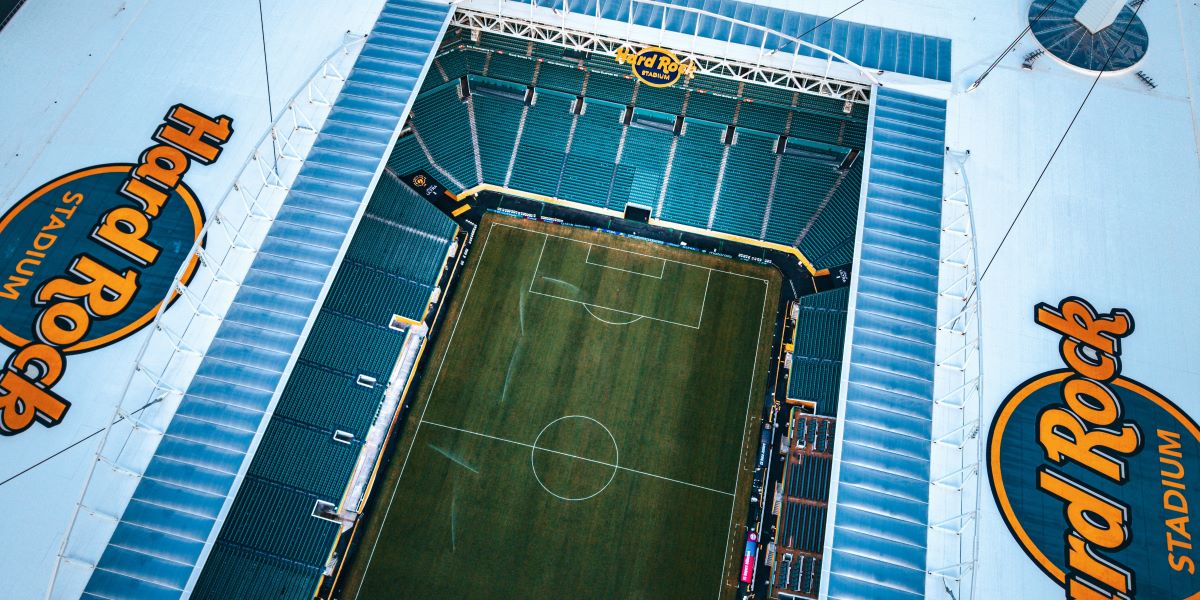
Scotland’s traveling support — the self-styled Tartan Army — has arrived in South Florida ahead of the team’s June 24 Group C match against Brazil at Hard Rock Stadium in Miami Gardens, and the invasion is already drawing local headlines. WSVN reported Tuesday that Scottish fans are planning a march from Ball and Chain in Little Havana to loanDepot Park for a Miami Marlins game against the Texas Rangers, bringing kilts, flags, and a simple operating philosophy to the city: “No Scotland, no party.”
The scene is not unfamiliar to Miami, a city that has absorbed international fan cultures since Lionel Messi’s arrival at Inter Miami in 2023 turned South Florida into an epicenter of global football attention. But the Tartan Army operates at a different register — less celebrity, more communal. Scotland is appearing in its first World Cup since 1998, and the fans who have crossed the Atlantic are treating the trip as a once-in-a-generation pilgrimage. They have already turned heads at Yankee Stadium in New York, where MLB’s official account posted video of the Scottish contingent taking over sections of the Bronx ballpark on June 17.
Seven Matches, Five Weeks, One Open-Air Stadium
Hard Rock Stadium in Miami Gardens hosts seven total World Cup fixtures through July 18, giving the city one of the longest and heaviest match calendars of any U.S. host. The schedule opened June 15 with Saudi Arabia vs. Uruguay (a 3-1 Uruguay win) and runs through the Bronze Final on the tournament’s penultimate day.
The remaining Miami fixtures: Uruguay vs. Cape Verde on June 21 at 6 p.m. ET; Scotland vs. Brazil on June 24 at 6 p.m.; Colombia vs. Portugal on June 27 at 7:30 p.m.; a Round of 32 knockout match on July 3; a quarterfinal on July 11; and the Bronze Final on July 18. The knockout-round opponents will be determined by group-stage results, but the confirmed group fixtures already guarantee that Brazil, Uruguay, Portugal, Colombia, and Scotland will all bring their traveling supporters through South Florida within a 12-day window.
For a stadium that has hosted Super Bowls, the Miami Open, and the Formula 1 Miami Grand Prix, the World Cup represents a different kind of operational challenge. The tournament is not a single event but a sustained five-week cycle of load-ins, crowd management, transit coordination, and — above all — heat mitigation.
Heat Is the Defining Variable
Hard Rock Stadium is an open-air venue. It has a canopy-style roof that provides partial shade over the seating bowl, but it does not have air conditioning. That distinction makes Miami one of the highest heat-risk host cities in the tournament.
Climate analysis published by NPR ahead of the tournament found that Miami’s combination of high temperatures and extreme humidity makes conditions particularly dangerous for extended outdoor activity. Unlike Monterrey, which runs hotter on the thermometer but in dry heat, Miami’s humidity prevents sweat from evaporating efficiently off the skin, raising the risk of heat illness for players and spectators alike. The National Weather Service issued an extreme heat warning during the June 15 match week, the tournament’s first match day in Miami.
Research modeling historical Wet Bulb Globe Temperature conditions — a composite metric integrating temperature, humidity, wind, and solar radiation — identified Miami as one of four host cities where most June and July afternoons exceed the 82.4°F WBGT threshold considered high-risk for prolonged outdoor exposure. Dallas, Houston, and Monterrey round out the group.
FIFA confirmed in early June that spectators may bring factory-sealed water bottles into matches at U.S. and Canadian venues, a policy adjustment that followed advocacy from player unions and public health researchers. FIFPRO, the global players’ union, had expressed concern about player safety at the tournament prior to kickoff. Hydration breaks are built into the match protocol when temperature thresholds are reached.
Miami Beach Turns Into a Five-Week Fan Zone
Off the pitch, South Florida’s hospitality infrastructure has oriented around the tournament. The City of Miami Beach published a dedicated World Cup events portal listing public watch parties at the Sand Bowl behind the Miami Beach Bandshell, bar and restaurant partnerships with match-day viewing across Lincoln Road and Collins Avenue, and a Uruguayan pride celebration at the Bandshell on June 20 produced in partnership with the Consulate General of Uruguay in Miami.
The iconic Miami Beach sign at Ocean Drive and 5th Street is now surrounded by 48 flags representing every qualifying nation. Bars from South Beach through Brickell and into Little Havana are running World Cup viewing schedules through July 19, with international sports bars arranging special events for visiting supporter groups. Ole Ole Steakhouse on Lincoln Road broadcasts every match on a giant screen. Burgermeister is running a World Cup-themed menu with limited-edition drinks served in collectible stadium-style aluminum cups.
For the Tartan Army specifically, the scene will peak on June 24 — Scotland’s final group-stage match. The fixture against Brazil carries historical weight: Scotland has never advanced beyond the World Cup group stage in eight previous tournament appearances, dating back to 1954. A result against Brazil in Miami would be one of the most significant moments in the history of Scottish football.
What the Tournament Window Means for the City
Miami’s seven-match allocation positions the city as one of the tournament’s anchor venues from start to finish, with the Bronze Final on July 18 guaranteeing South Florida remains in the global spotlight through the tournament’s final weekend. The economic and logistical footprint extends well beyond match days — hotel bookings, airport traffic at MIA, restaurant spending, and transit load all run at elevated levels across the full five-week window.
For residents, the practical advisory remains the same the city has issued for every major Hard Rock Stadium event: plan for traffic, use transit or rideshare where possible, and expect crowd density in Miami Beach, Brickell, and the stadium corridor on match days. For visitors, the advisory is simpler: bring water, seek shade, and respect the heat. Miami in late June is not a metaphor. It is 90 degrees and 75% humidity, and the football is outdoors.