You spent twenty minutes on your hair this morning. Looked good leaving the house. Genuinely good. Then you stepped outside into what can only be described as air you could chew, and somewhere between the front door and the car your entire head decided to pursue a second career as a mushroom cloud.
There’s a reason thick hair and humid weather have the kind of relationship that should probably involve a mediator. Your shampoo for thick hair was designed in a room with air conditioning and zero atmospheric moisture. It passed every test in that room. You don’t live in that room. You live somewhere the air has weight to it four months a year, and your hair treats that weighted air as a personal invitation to absorb everything it can reach.
The Physics Your Hair Didn’t Ask You to Learn
Thick hair has a wider shaft with cuticle layers that sit slightly more open than what you’d find on a fine strand. In February, background noise. In July, the whole story.
Open cuticle in humid air works almost exactly like leaving a dry sponge on a wet countertop. It absorbs. Automatically. The shaft takes on water from the atmosphere whether you gave permission or not, swells outward, and the cuticle lifts further as the internal structure expands. The sleek ponytail you left the bathroom with is now a volume experiment happening on your head without your consent.
Your shampoo for thick hair needed to prepare the strand for this during the wash, before anything else touched the hair. Most formulas aren’t thinking about atmospheric conditions during formulation. They’re thinking about lather feel and fragrance notes. The weather wasn’t invited to the product meeting.
Ingredients That Survive Contact With Actual Weather
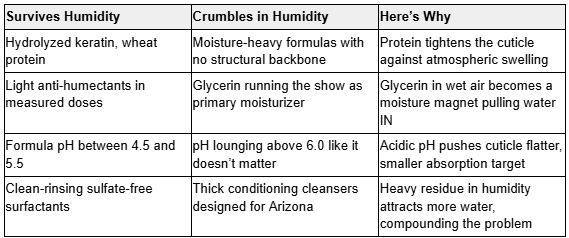
The glycerin situation deserves extra attention. Every hair care resource recommends it. They’re not wrong. In dry air, glycerin pulls moisture toward the strand from wherever it can find some. Brilliant. In humid air, “wherever it can find some” means the entire saturated atmosphere surrounding your head, and suddenly your hair is importing moisture faster than you can manage it. Same ingredient. Completely opposite outcome. The weather rewrote the rules, and nobody updated the advice.
Why the Products That Feel Best Are Usually the Worst Choice
Shampoo for thick hair loaded with shea butter and rich oils feels phenomenal during the wash. Soft, cooperative, like the product finally gets it. That feeling lasts until approximately ninety seconds after stepping into humid outdoor air, at which point all that pre-loaded moisture becomes a homing signal for every water molecule floating around looking for somewhere to land.
You pre-hydrated the strand and walked it into a hydration surplus. The math was never working out.
People reach for heavy silicone formulas next because sealing everything out sounds logical. On thick hair in humidity, heavy silicones create a different but equally frustrating problem:
• Weight stacks with each wash, gravity wins, volume loses
• Conditioning ingredients can’t penetrate the silicone fortress to reach actual hair
• The strand looks dull and glazed rather than shiny because light bounces off silicone differently than clean cuticle
• Removing build-up requires stripping washes that take good stuff out alongside bad
Your Winter Bottle and Summer Bottle Shouldn’t Be the Same Bottle
People resist this because two shampoos feel excessive. It’s just admitting what your hair has been communicating through months of seasonal frustration.
Summer wants a shampoo for thick hair that leans protein-forward, keeps glycerin minimal, includes anti-humectant properties, and rinses clean without residue that humid air grabs onto. Winter wants richer emollients, more glycerin, heavier conditioning because the atmosphere is stealing moisture instead of donating it.
Same head. Different atmospheric opponent. Different formula required. Trying to split the difference with one year-round bottle is like bringing a rain jacket to a snowstorm and wondering why you’re cold. Both involve water from the sky. Both need completely different equipment.
What Thick Hair Needs When the Air Turns Heavy
Humidity and shampoo for thick hair only work together when the formula respects what humid air physically does to a wide, open-cuticled strand. The moisture pushes in. The shaft expands. The morning style gets quietly demolished by chemistry the wash didn’t prepare it for.
Protein when the air is heavy. Anti-humectants when humidity crosses the line. Lighter formulas when weather turns warm and wet. And a willingness to admit your January shampoo has no business showing up in your July shower.
Your hair wasn’t being difficult about the weather. The shampoo was just underprepared for the conversation.
Disclaimer: This article is for general informational and educational purposes only. Hair type, texture, scalp condition, and response to hair care products can vary from person to person. Ingredient performance may also differ depending on environmental conditions and individual hair needs. Readers should review product ingredients carefully and consult a qualified hair care professional or dermatologist if they have concerns about their hair or scalp. References to specific ingredients or products should not be interpreted as guarantees of particular results.