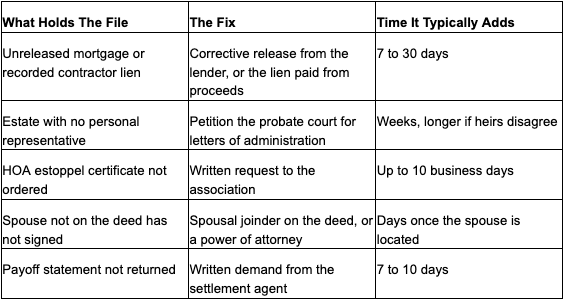
A HomeWise closing delay almost always comes from the title side rather than the money side. The usual causes are an old mortgage that was never released, a lien filed by an unpaid contractor, an estate that still needs letters from the probate court, an HOA estoppel letter, a spouse whose signature is required, or a payoff statement the lender is slow to send.
Consider a hypothetical estate in Hialeah, Florida. A 1962 three-bedroom passes to a daughter in January 2026; she signs a cash contract in March at $268,000 with a 14-day closing window, and the title search returns three problems: a second mortgage from 2003 that was paid but never released, a $6,400 lien recorded by a roofing contractor in 2019, and no letters of administration, because nobody opened an estate. The buyer did not walk. Closing moved to late April while the title company chased a corrective release, negotiated the contractor payoff, and waited on the court.
Why Does A Closing Date Slip On The Title Side?
Because a deed transfers only what the public record says the seller owns, and the record is often out of date. Each of the six common holdups has a known fix and a rough clock.
- An unreleased old mortgage. The loan was paid off years ago, but the satisfaction never reached the county. Section 701.04 of the 2026 Florida Statutes requires the lender to record a release within 60 days of full payment. When that did not happen, the title company writes to the servicer for a corrective satisfaction.
- A contractor’s lien. A roofer or remodeler who was never paid can record a claim against the property. It does not stop the sale. The amount is negotiated, paid from the seller’s proceeds, and released with the deed.
- An estate with no letters. Heirs cannot sign a deed for a dead owner. The probate court appoints a personal representative, and the letters it issues are what a title company accepts as authority to sell.
- An HOA estoppel letter. The association states what the property owes. In Florida, it has 10 business days from a written request, and its certificate is the only figure the closing table will use.
- A missing spouse signature. Under the Florida Constitution, a married owner of homestead property must be joined by the spouse to sell it, even when that spouse is not on the deed. A separated spouse turns a signature into a search.
- A slow payoff statement. Nothing is disbursed until the lender states the exact balance. Section 701.04 gives a servicer 10 days to answer a written request, and federal Regulation Z allows no more than seven business days for a payoff statement.
How Long Do Title Searches Take Once A Contract Is Signed?
The HomeWise explainer on the cash offer process puts a clean search at 5 to 10 business days and says unpaid liens, missing probate paperwork or a disputed ownership question can add another 7 to 30 days on top. That is the spread behind any advertised timeline, and the calendar belongs to the county recorder.
According to section 720.30851 of the 2026 Florida Statutes, an association must issue an estoppel certificate within 10 business days of receiving a written or electronic request, and an association that misses the deadline may not charge for preparing it. Two weeks is the outer edge for that one document, which is why closers order it the day the contract is signed.
Does The Search “Can You Sell A House That Is In Probate” Have A Short Answer?

Not quite. Selling a house in probate is routine, but only after the court appoints someone with authority to sign. The Miami-Dade Clerk of the Courts states on its probate court page that “The probate of all wills and granting of letters must be in the state and county where the deceased lived.” Heirs who try to sell before that appointment find the title company will not insure the transfer. Anyone acting for an estate should work with a licensed attorney in that state, because the appointment, the creditor notice and the deed all run through the court file.
Old title problems outlast their owners. Home Closing 101, the consumer site of the American Land Title Association, lists unpaid mortgages, unpaid taxes, child support liens, and missing heirs among the defects an owner’s policy covers, and it warns that “Fraud and forgery are examples of hidden title hazards that can remain undetected until after a closing despite the most careful precautions.” A search that surfaces one of those before closing has done its job.
Where Does A Direct Buyer Change The Math?
HomeWise, a direct home-buying company that purchases distressed single-family houses in California, Texas, Florida, Arizona, Georgia, and other states, buys as-is with no repairs or showings, closes in as little as seven days once title is clear, and lets the seller pick a date up to 60 days out. It charges no agent commissions, listing fees, or service fees and, in most cases, covers standard closing costs, with prorated property taxes and HOA dues owed at settlement still deducted at the table. Its guide to the closing steps in a cash sale sets out the same six steps a title company follows.
A flexible closing date is worth more than a fast one when an estate or a lien is involved, and buyers such as HomeWise usually take the later date rather than lose the file. Owners typing “sell house fast” after a date has already slipped are better served by opening the probate petition or the estoppel request before signing a contract. Questions about a specific file go through the company’s published contact channels.
Frequently Asked Questions
Can A Closing Be Rescheduled Without Losing The Offer?
Usually, yes, when both sides sign an amendment moving the date. A direct buyer that has already underwritten the property has little reason to walk away over a title item with a known fix. What a seller should avoid is silence, since a buyer with no explanation starts weighing other files.
What Does Selling A House In Probate Require Before Closing?
A personal representative appointed by the probate court, letters issued in that person’s name, and a deed signed in that capacity. Depending on the state and the estate, notice to creditors or a court order approving the sale may also be needed. The title company lists its requirements once it reviews the file.
Who Pays A Contractor Lien At Closing?
The seller does, out of the sale price. The settlement agent negotiates the amount with the lienholder, deducts it on the settlement statement, pays it at disbursement, and records the release. The seller’s net drops by that amount, and the buyer receives title free of the claim.
Does An HOA Estoppel Letter Really Take Two Weeks?
It can. Florida gives associations 10 business days from a written request, and many take the full period, especially when a management company handles the paperwork for several communities. The certificate fixes the dues, fines, and transfer fees owed, so no settlement statement is final until it arrives.