By: Ethan Rogers
A dataset can pass every catalog, lineage, quality, and access check, then become dangerous five minutes later. The failure begins when someone removes its business context, combines it with another source, feeds it into a model, or uses its output to approve a claim, price a product, or flag a customer.
Most governance programs concentrate on where data is stored, who owns it, and whether it meets technical standards. Yet risk usually emerges later, when data shapes an action.
This is why AI data governance must begin at the consumption layer. The relevant question is, “Is this use appropriate, explainable, monitored, and attributable?”
Why Storage-Centric Data Governance Falls Short?
Traditional data governance was designed around repositories. Teams classified tables, assigned stewards, documented lineage, set retention rules, and restricted sensitive fields. It worked when data moved into stable reports with known users and predictable queries.
AI changes the operating conditions. A single approved source may now support:
- A finance dashboard used for monthly reporting
- A retrieval system that adds context to employee prompts
- A predictive model that ranks customer risk
- An automated workflow that routes cases without manual review
- A generative assistant that rewrites internal data for external use
The source remains identical. The risk profile changes with each use.
Storage controls cannot determine whether a model applies data outside its intended purpose. A catalog cannot detect when a dashboard metric loses an exclusion rule. Lineage cannot decide whether a recommendation deserves human review. Access control cannot explain why an output was accepted.
The missing discipline is data consumption governance. It governs the conditions under which approved data may influence analysis, automation, communication, and decisions.
What Is the Data Consumption Layer?
The data consumption layer is where governed data becomes business input. It includes semantic models, dashboards, feature pipelines, prompts, APIs, decision rules, workflow engines, spreadsheets, and review screens.
This layer needs treatment because consumption changes meaning. A field called “customer status” may look harmless in a warehouse. In a collections model, it can affect contact priority. In a service dashboard, it may indicate account health. In a generative tool, it may enter a customer response.
The same field carries different obligations in each setting.
A practical AI governance framework therefore needs two linked views:
- Asset governance, which covers the condition, ownership, lineage, quality, and protection of data.
- Use governance, which covers purpose, context, decision impact, controls, review, and evidence.
Few operationalize the second.
How Data Becomes Risky After It Is Approved?
Consumption risk enters through interpretation, combination, automation, and redistribution.
1. Interpretation Changes the Meaning
Dashboards often present governed data through calculated metrics, filters, and labels. A technically correct query can still produce a misleading measure if business definitions are incomplete.
Consider “active customer.” One team may mean a purchase in 90 days. Another may include open contracts. A model may infer activity from application usage. Trouble begins when the definition is hidden.
2. Combination Creates a New Risk Class
Two low-risk datasets can become sensitive when joined. Employee location data may be acceptable for workforce planning. Performance data may be acceptable for manager review. Combined in an AI model, they could support inappropriate profiling.
AI data governance must evaluate the assembled input and its individual parts.
3. Automation Removes Natural Checkpoints
A dashboard informs a person. A workflow can act before anyone notices an error. Once data triggers account suspension, payment review, inventory changes, or customer communication, governance becomes part of operational control.
This is where governed analytics workflows connect definitions, decision rules, review thresholds, and audit evidence to the work itself.
4. Redistribution Breaks the Original Boundary
Generative AI makes internal data easy to summarize, rewrite, and circulate. Legitimate source access can still produce an inappropriate external output. Permission to read does not grant permission to publish a derived statement.
The Four Controls That Matter at the Point of Use
A consumption-layer control model should answer four questions: who can use the data, what context must travel with it, which uses are permitted, and who is accountable for the result.
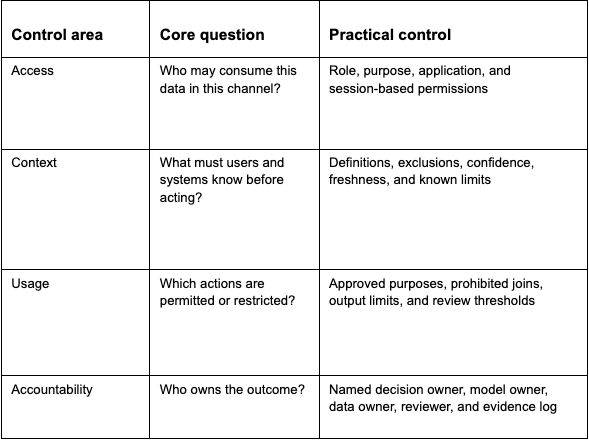
These controls should travel with the data product or service. A policy in a separate portal is easily missed under pressure.
Access Must Reflect Purpose, Not Only Identity
Most access models ask whether a person may open the source. AI systems require a more precise test.
A user may view support records yet be restricted from model training. An analyst may query transactions for fraud monitoring yet lack approval for marketing segmentation. A service agent may receive a recommendation without seeing sensitive attributes behind it.
Purpose-aware access adds conditions such as:
- Approved business objective
- Permitted application or model
- Allowed output type
- Geographic or contractual boundary
- Required review level
- Expiry date for temporary use
This turns access into a controlled use agreement.
Context Must Stay Attached to Data
Many AI errors begin when context is stripped away. A number enters a feature pipeline without its unit. A status code reaches a prompt without its definition. A historical label is treated as current truth. A confidence score appears in a workflow without guidance on how it should affect action.
AI data governance should require context to move with the data through metadata, semantic definitions, prompt instructions, feature documentation, and user interfaces, supported by data engineering services that maintain lineage, metadata, and data product controls.
Consumers should see:
- Business meaning
- Source and update time
- Intended purpose
- Known exclusions
- Quality or confidence limits
- Sensitive-use restrictions
- Contact for clarification
Context is part of the control surface. Without it, accurate data can support a poor decision.
Usage Policies Must Be Enforceable
A policy that says “use responsibly” offers little protection. Rules must be specific enough to enforce and test.
A good rule states the data, permitted purpose, consuming system, decision impact, review, and retained evidence.
For example:
Customer complaint text may support service-quality analysis. It may not be used to infer medical, financial, or personal characteristics. Any generated customer response must be reviewed before release.
That rule can be mapped to prompt filters, approved model routes, output checks, workflow gates, and audit logs.
This is the practical core of data consumption governance. It converts broad principles into controls that sit inside the path from data to action.
Accountability Must Follow the Decision
Data ownership alone is insufficient. The data owner can confirm that a source is accurate and properly classified. They cannot own every conclusion drawn from it.
AI data governance requires a decision owner. This role is accountable for output use, review level, and the response to harm or error.
A clear accountability map should identify:
- The data owner, responsible for source fitness
- The model or analytics owner, responsible for logic and performance
- The workflow owner, responsible for action rules
- The decision owner, responsible for business consequences
- The reviewer, responsible for exceptions and contested outcomes
This prevents each team from owning a component while nobody owns the result.
How to Build Governance into Analytics and AI Workflows?
In AI data governance, controls belong inside existing work. Users should not leave a dashboard, model interface, or case screen to understand permitted action.
Effective governed analytics workflows include five elements:
- Visible definitions- Metrics, labels, and scores show their business meaning.
- Use notices- Sensitive or limited-purpose data displays restrictions before use.
- Decision gates- High-impact actions require approval or second review.
- Exception paths- Users can challenge outputs and record why.
- Evidence capture- Inputs, versions, rules, approvals, and outcomes are logged.
These controls make governance observable and produce evidence for audits, incidents, model assessments, and policy improvement.
A Practical Operating Model for AI Data Governance
Enterprises can begin with high-impact consumption paths instead of governing every query at once.
Identify where data affects customers, employees, money, access, compliance, or public communication. Map the route from source to decision, including each interpretation, join, model, rule, interface, and handoff.
Then apply a consumption review:
- Is the purpose explicit?
- Is the data suitable for that purpose?
- Is required context visible?
- Are restricted uses blocked?
- Is human review placed where impact rises?
- Can the final decision be traced?
- Is one role accountable for the outcome?
This review should enter product design, model release, dashboard approval, and workflow change management.
An effective AI governance framework also distinguishes between advisory and action-taking systems. Advisory outputs may need disclosure and user judgment. Action-taking systems need stricter thresholds, fallback behavior, approval logic, and incident procedures.
Governance Should Measure Decision Quality
Many governance teams report the number of cataloged datasets, assigned owners, completed assessments, or closed policy exceptions. These measures describe activity. They do not show whether data use is improving.
Consumption-layer metrics should examine:
- Decisions reversed after review
- Outputs used outside approved purposes
- Missing context at the point of action
- High-impact actions completed without required approval
- Repeated exceptions linked to one dataset or model
- Time needed to trace a decision to its inputs
- Harm, loss, or delay caused by poor data use
These measures connect governance with operational performance.
The Real Boundary of AI Governance
The meaningful boundary of governance is the decision. That is where data acquires consequence and controls must become specific, visible, and enforceable.
AI data governance succeeds when an enterprise can explain which data influenced an outcome, why that use was permitted, what context was available, which controls applied, who reviewed the result, and who owns the consequence.
Govern the source, certainly. Then follow the data until it becomes action. That is where trust is either preserved or lost.