Florida accounted for roughly one in nine new business applications filed in the United States in August, according to Census Bureau figures released Sept. 11, with 61,380 seasonally adjusted applications out of 531,728 nationwide. For local service businesses in the state’s growing metros, the numbers point to a quieter consequence: local search competition keeps intensifying, while the number of places a customer actually looks on a search results page stays roughly the same.
Key Takeaways
- Florida filed about 11.5% of U.S. business applications in August, according to Census Bureau data.
- Census estimates show three of the nation’s five fastest-growing metros by percentage are in Florida.
- New businesses compete for the same small set of map results and listings.
- Specific neighborhood pages, a complete Google Business Profile, steady reviews, and local coverage tend to separate businesses that stand out.
- Standing out typically takes months, and no one can guarantee a position.
Florida’s Business Boom Intensifies Local Search Competition
Census Bureau business formation data show Florida filed roughly 60,000 to 65,000 seasonally adjusted business applications each month from April through August 2026. Not every application becomes an operating company, but the series often signals early new business activity.
The Census Bureau’s March population estimates point to the same trend across much of the state. Ocala, Lakeland-Winter Haven and Punta Gorda were three of the five fastest-growing U.S. metro areas by percentage between July 2024 and July 2025, and the Orlando area added 37,690 residents.
Miami’s picture is more mixed. Miami-Dade County lost 10,115 residents over the same period, falling to 2,802,029, consistent with the Bureau’s finding that lower international migration weighed on the most populous counties. Population is only part of the picture, though, and a new competitor does not need population growth to appear in the same search results.
More Competitors, Same Small Set of Search Results
A local search has a fixed shape. For most service queries, Google shows a map with three businesses, followed by a short list of results. Each new plumber, dental office, law practice, or wellness studio competes for those same few spots, and the page does not get longer to make room.
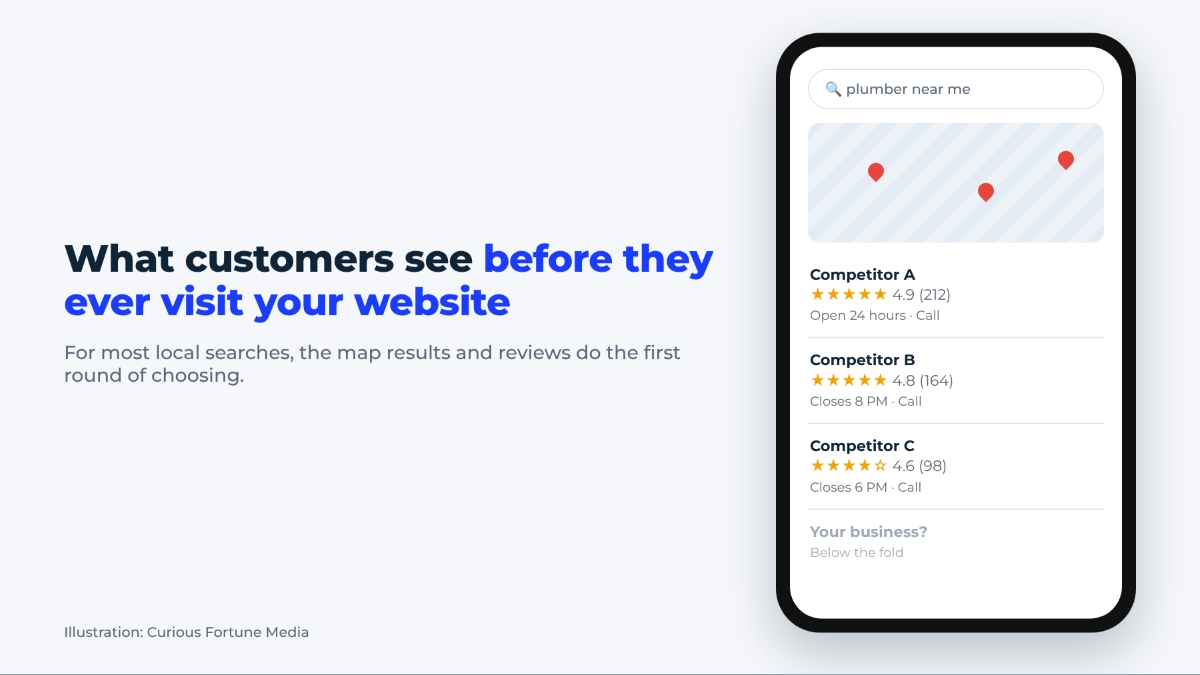
The pressure is sharper in markets that draw newcomers. People who recently moved often have no personal referrals to rely on, so they start with a search. Many new businesses also launch with similar basics, so South Florida businesses end up being compared on listings that look nearly identical.
“In a growing market, almost every new business shows up with the same starter kit: a website, a listing and a handful of reviews,” said Edmond Abramyan, founder of Curious Fortune Media. “Looking legitimate used to set a business apart. Now it’s the minimum, and customers end up choosing between options that all look the same.”
What Separates the Businesses That Stand Out
Specificity is often the first difference. A business with pages and profiles tied to the neighborhoods and services it actually covers, such as Brickell, Doral, Coral Gables, or Kendall, gives searchers and search engines more to match than one that describes itself only as serving “Miami.” In a bilingual market, content that serves Spanish-speaking customers can also add relevance.
Google’s guidance on local ranking says results are based mainly on relevance, distance, and prominence, with prominence shaped by factors such as reviews and links from other websites. That points to a few steady habits: a complete, accurate Google Business Profile; a steady flow of genuine online reviews; and mentions in local press coverage and community organizations.
Those pieces work best together, since a detailed profile, credible reviews, and local coverage reinforce one another. Abramyan developed the Authority Engine™ at Curious Fortune Media to connect visibility, authority, and conversion in that order, and in markets where new competitors keep arriving, the authority layer is usually what separates one similar-looking listing from the next.
In Los Angeles, Abramyan’s agency faced a version of this with The Balloon Guy, a luxury event decor company whose clients have included Nike, Disney, Miley Cyrus and many more high-profile names. The reputation was already there. The job was making it just as visible online, through a rebuilt website, SEO, content and press, so searchers could see what set the business apart from look-alike competitors.
Growth Raises the Bar, Not the Odds
Growth can also erase early advantages. A business that ranked well two years ago may now share its results page with several newer rivals, and more continue to file every month. Building visibility typically takes months, and no one can guarantee a position. AI-generated answers, which often summarize a few local options before any listing appears, add another layer of selection that businesses cannot directly control.
“Growth raises the bar. It doesn’t raise the odds,” Abramyan said. “The businesses that hold their ground are the ones that keep adding proof every month, because the next competitor is always on the way.”
For owners across South Florida, growth brings customers but keeps adding competitors for the same handful of search positions. Instead of relying on being listed, businesses can get more by being specific about real neighborhoods and real services and by building proof steadily over time. As the region keeps drawing new companies, the businesses that stand out may be the ones customers and search engines can most easily tell apart.
Frequently Asked Questions
Why is it harder for local businesses to stand out in fast-growing areas?
New businesses keep entering the market, but local search results still show only a few businesses at the top, so more companies compete for the same visible spots.
How many new businesses are being started in Florida?
Census Bureau data show 61,380 seasonally adjusted Florida business applications in August 2026, about 11.5% of the national total. Not every application becomes an operating business.
What helps a local business appear in Google’s map results?
Google says local results are based mainly on relevance, distance, and prominence, including reviews and links from other websites. A complete, accurate Google Business Profile is a starting point.
How does local search competition affect new businesses?
New businesses often start with few reviews and little local coverage, so they may need months to compete with established listings, and results vary by trade and neighborhood.